

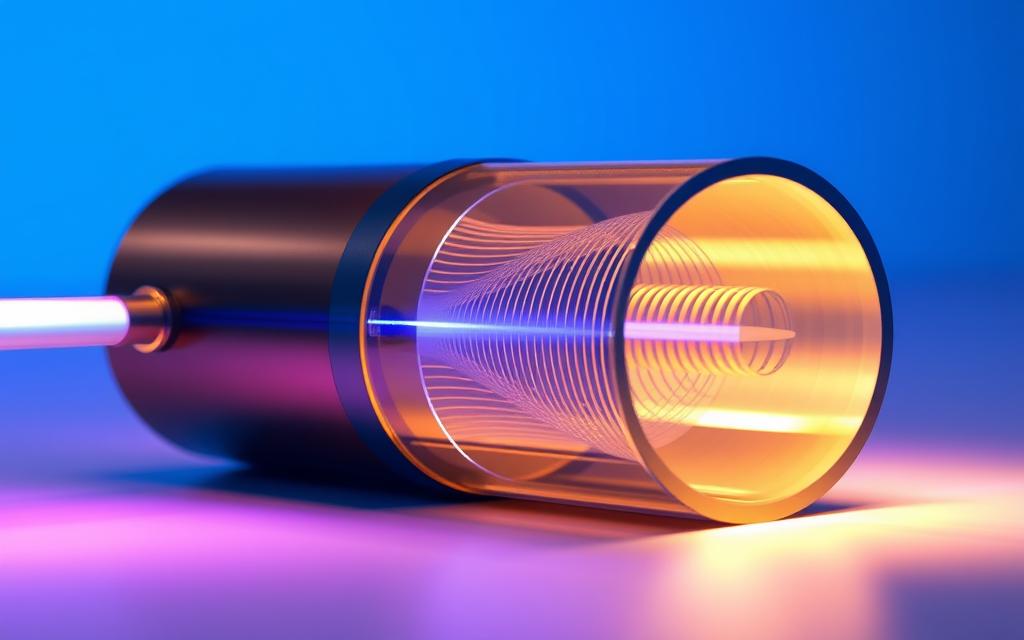
LASER stands for Light Amplification by Stimulated Emission of Radiation. This technology is a major scientific breakthrough of our time.
It works by exciting electrons in atoms to higher energy levels. When these electrons drop back, they release photons of laser light.
This is different from regular light sources. Stimulated emission in lasers creates coherent, focused beams. This is not seen in ordinary bulbs.
The light amplification results in a beam that is intense and directional. This beam has changed many fields, from medicine to manufacturing.
Knowing how lasers work helps us understand their uses. The unique stimulated emission makes lasers so powerful.
The Fundamentals of Laser Technology
Learning about laser technology starts with understanding its basics and history. These basics show why lasers are different from regular light sources. They also explain how lasers have changed many areas of life.
Defining Laser and Its Core Principles
A laser is a device that amplifies light through a special process. This process makes the light unique, unlike the light from bulbs or LEDs.
The main laser principles are about coherence, monochromaticity, and direction. These features make lasers very special.
Coherence means the light waves stay in sync. This keeps the laser beam sharp over long distances. It doesn’t spread out like normal light.
Related Posts:
- How Technology Affects the Labor Market Automation…

- How Technology Affects Ethics New Moral Dilemmas in…

- What Is Construction Technology and Management…

- Is a Watch a Technology The Evolution of Timekeeping

- How Technology Can Increase or Decrease Environmental Impact

- How to Survive Without Technology A Guide to Unplugging

Monochromatic light is light of just one colour or wavelength. Unlike white light, laser light is very focused. This makes it perfect for many uses.
Directionality is when the laser sends out light in a narrow beam. This precise beam is great for many things, like in medicine and science.
Together, coherence, monochromaticity, and direction make lasers very powerful. They can do things that regular light can’t.
Historical Development of Laser Technology
The story of lasers started in the 1950s with some big ideas. Charles H. Townes and Arthur Leonard Schawlow worked on the maser. It was a way to amplify microwave radiation.
Their work was a big step towards lasers. They were very important in the early days of laser technology.
In 1960, Theodore Maiman made the first working laser. He used a synthetic ruby crystal to show that light could be amplified at optical wavelengths.
Maiman’s achievement was a big leap forward. It moved lasers from theory to reality. His work was built on the ideas of Townes and Schawlow.
After Maiman’s success, lasers quickly evolved. Many new types of lasers were developed in the 1960s. Each new laser opened up more possibilities in different fields.
Key Components of a Laser System
Every laser system has three main parts that work together. These parts are key to making coherent light. Knowing about them helps us understand how lasers are so precise and powerful.
Gain Medium: The Heart of Light Amplification
The gain medium is the heart of a laser. It’s where light gets amplified. This part is made of atoms, molecules, or ions that can get excited.
When these particles go back to their normal state, they release photons. This process is called stimulated emission.
The type of gain medium used affects the laser’s properties. It decides the laser’s wavelength, power, and how efficient it is. Different materials are used for different needs in various industries.
Types of Gain Media: Solid, Liquid, and Gas
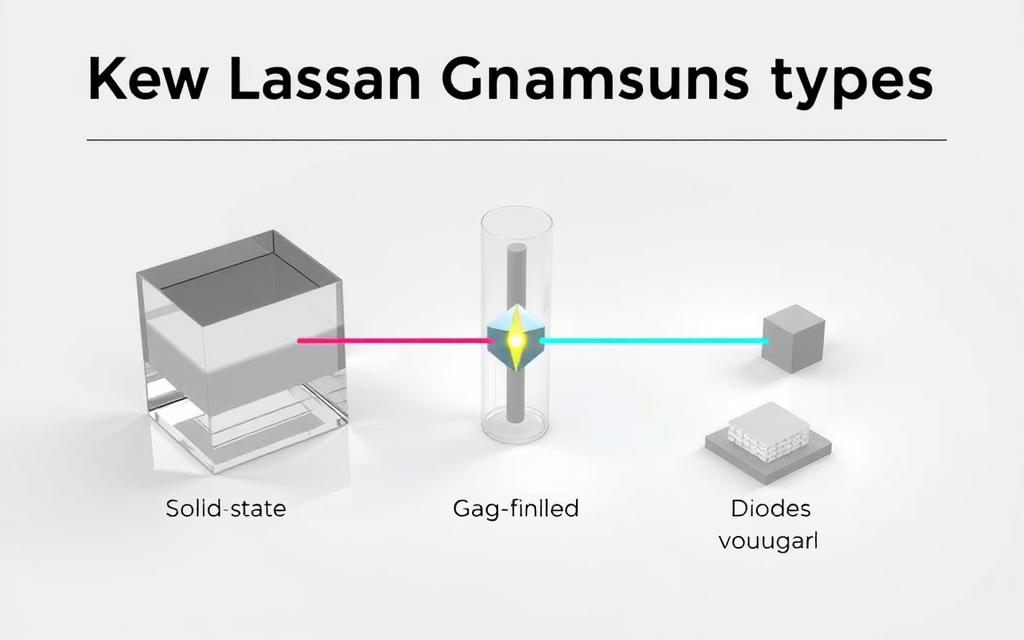
Lasers are mainly classified by their gain medium. Solid-state lasers use materials like crystals or glass doped with ions. Ruby and Nd:YAG lasers are examples of this.
Gas lasers use gases as their active medium. Helium-neon and carbon dioxide lasers are common here. They produce light that’s very coherent and stable.
Liquid lasers are less common but use dye solutions. They can change wavelength by changing the dye. This makes them useful in research and spectroscopy.
Pump Source: Energy Input Mechanism
The pump source gives the energy needed to excite atoms in the gain medium. This excitation is what starts the light amplification process. It creates a state called population inversion.
There are different ways to pump a laser, depending on the gain medium:
- Optical pumping with flash lamps or lasers
- Electrical discharge in gases
- Direct current in semiconductor lasers
- Chemical reactions in special systems
The pump source’s efficiency affects the laser’s performance and cost. Today, diode lasers are often used because they’re small and efficient.
Optical Cavity: Mirrors and Resonance
The optical cavity, or resonator, is the last part of a laser system. It’s where the light gets amplified. It usually has two mirrors, one that reflects all light and the other that lets some out.
Photons bouncing between these mirrors make more photons. This creates a chain reaction that amplifies the light.
The design of the optical cavity affects many laser properties:
- Beam direction and quality
- Spectral purity and linewidth
- Output power and efficiency
- Mode structure and quality
Getting the mirrors just right is key for the laser to work well. The distance between them also affects the laser’s output spectrum.
How Does Laser Technology Work: The Amplification Process
Laser technology’s magic happens in the amplification process. Here, ordinary light turns into the strong, focused beam we know as laser light. This change relies on precise physical principles working together perfectly.
Stimulated Emission and Population Inversion
At the heart of laser operation is stimulated emission. This is the key process that creates identical photons. When an excited atom meets a passing photon, it releases another photon with the same wavelength, phase, and direction.
To make this happen, we need population inversion. This is a special state where more atoms are in higher energy levels than lower ones. This non-equilibrium state is the fuel for light amplification.
Energy Levels and Electron Transitions
Atoms have electrons in specific energy levels. By adding energy, we excite these electrons to higher states. When they drop back to lower levels, they release energy as photons. This can happen through spontaneous or stimulated emission.
Coherent Light Generation
The optical cavity is key in creating coherent light. Mirrors at each end reflect photons back and forth. This creates a chain reaction of stimulated emissions that increases light intensity while keeping everything in sync.
Properties of Laser Light: Monochromaticity and Directionality
Laser light has amazing properties that set it apart from regular light. Its monochromatic nature means all photons have the same precise wavelength. This creates pure, single-colour light.
The beam’s exceptional directionality lets it travel long distances without spreading much. This tight focus makes lasers perfect for precise targeting over long distances.
Common Types of Lasers and Their Mechanisms
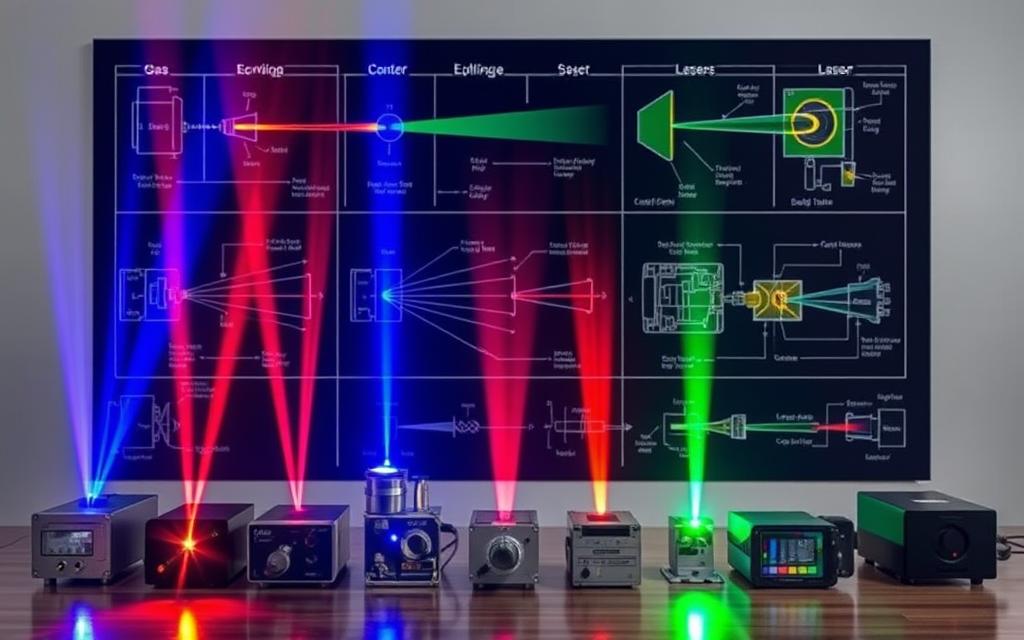
Lasers come in many forms, each made for different uses. They use different materials and ways to work. Knowing about these laser types shows how they are used in many fields. The main difference is the gain medium, which affects the laser’s features and uses.
Gas Lasers: Helium-Neon and Carbon Dioxide Examples
Gas lasers use a gas mixture as their gain medium. They have special benefits for certain tasks. The Helium-Neon (gas laser) is well-known for its red beam, seen in old laser pointers. It works by electrical discharge exciting gas atoms, creating coherent light.
Carbon dioxide lasers are another key gas laser type. They make strong infrared light, perfect for cutting and welding in industry. Their power and efficiency are key for precise material work.
Solid-State Lasers: Ruby and Nd:YAG Lasers
Solid-state lasers use a solid material, like a crystal or glass, as their gain medium. The ruby laser was the first working laser in 1960. It uses a synthetic ruby crystal to make deep red light pulses.
Neodymium-doped Yttrium Aluminium Garnet (Nd:YAG) lasers are more advanced. They can work in continuous or pulsed modes. They are used in many areas, from medicine to marking, because of their strength and reliability.
Semiconductor Lasers: Diode Lasers in Everyday Use
Semiconductor lasers, or diode lasers, have changed laser tech with their small size and efficiency. They use semiconductor materials, like in computer chips. This makes them small and easy to make in large numbers.
Diode lasers are everywhere in everyday items. They power DVD and Blu-ray players, barcode scanners, and laser pointers. Their size and low power use make them great for small devices.
Each laser type has its own benefits for different needs. From the precision of gas lasers to the power of solid-state lasers and the ease of diode lasers, knowing the differences helps choose the right one. For more info on laser types and their uses, check out our detailed guide.
Applications of Laser Technology Across Industries
Lasers have changed many fields in amazing ways. They bring precision, coherence, and power to our work. This has changed how we heal, make things, and talk to each other.
Medical Uses: Surgery and Dermatology
In healthcare, medical laser systems are very precise. Surgeons use them for detailed work like LASIK eye surgery. They can make very small changes with great accuracy.
Dermatologists use lasers to treat skin problems, remove tattoos, and make skin look younger. They use different types of lasers to target specific skin issues without harming the rest.
- Precise tissue ablation in surgical procedures
- Selective photothermolysis in dermatology
- Minimally invasive treatments with faster recovery
Industrial Applications: Cutting and Welding
In manufacturing, industrial laser systems are key for working with materials. They cut through metals, plastics, and more with great accuracy. This means cleaner cuts and less waste.
Laser welding makes strong, precise joints in cars and planes. It heats the area just right, making sure the material doesn’t warp. It’s also used for engraving and marking things.
Communications and Data Storage
The digital world relies on laser communications. Laser pulses send lots of data over long distances. This makes fast internet and global connections possible.
CDs, DVDs, and Blu-rays use lasers to read and write data. They focus on tiny marks on discs to turn them into digital information. Barcode scanners and laser printers also use this tech in daily life.
These laser applications show how one technology can change many areas. Lasers help save lives, make products, and connect us all. They keep pushing the boundaries of what’s possible.
Conclusion
Theodore Maiman’s 1960 invention at Hughes Research Laboratories changed many fields. It introduced stimulated emission and coherent light. These ideas led to many uses in medicine, industry, and communications.
Lasers are now key in our technology world. They help in precise surgeries and fast data transfer. This shows how lasers are vital today.
The future of lasers looks bright. Research is making them even more useful. They’re being used in quantum computing, advanced manufacturing, and photonic integration.
For more on lasers, check out this detailed overview. It shows how lasers keep advancing science and technology.
Laser technology is a major breakthrough of our time. Its special features allow for new solutions. As laser systems improve, they will lead innovation in many areas for years.
FAQ
What does the acronym “laser” stand for?
“Laser” means “Light Amplification by Stimulated Emission of Radiation”. It’s a device that makes a beam of light. This beam is coherent, monochromatic, and directional.
How is laser light different from ordinary light, such as that from a light bulb?
Laser light is coherent and monochromatic. It has a single colour or wavelength. On the other hand, light from a bulb is incoherent, polychromatic, and diffuse.
What are the key components of a laser system?
A laser system has three main parts. The gain medium is where stimulated emission happens. The pump source gives energy for population inversion. The optical cavity has mirrors to reflect photons and amplify the light.
What is meant by “population inversion” in laser technology?
Population inversion means more electrons are in a higher energy level than a lower one. This is needed for stimulated emission to happen. It allows light to be amplified.
Can you name some common types of lasers and their uses?
Sure. There are gas lasers like the Helium-Neon laser for alignment. Solid-state lasers, like Ruby and Nd:YAG, are used for cutting and welding. Semiconductor lasers are in DVD players and laser pointers.
How are lasers used in medical applications?
Lasers are used in medicine for precise tasks. They’re used in LASIK eye surgery and for skin treatments. They’re also used in surgeries where precision is key.
What role do lasers play in industrial settings?
In industry, lasers are key for material processing. They’re used for precise cutting, welding, and engraving. Their accuracy and efficiency are valuable in manufacturing.
How do lasers contribute to communications and data storage?
Lasers are vital for fibre-optic communications. They enable fast data transmission over long distances. They’re also used in optical disc drives for reading and writing data.
Who were the key figures in the development of laser technology?
Charles Townes and Arthur Schawlow laid the theoretical foundations. Theodore Maiman demonstrated the first operational laser in 1960. His use of a ruby crystal was a key moment.
Why is the optical cavity important in a laser?
The optical cavity is formed by mirrors at each end. It creates a resonant environment. This allows photons to be reflected back and forth, amplifying the light into a coherent beam.