

Imagine waking up to complete silence. No smartphone notifications, no internet connection, no digital devices of any kind. Our modern world would experience a profound shift overnight.
Medical advancements would vanish, social media platforms would disappear, and our fast-paced existence would suddenly slow to a natural rhythm. This radical change presents both challenges and opportunities.
We would rediscover face-to-face connections and develop a deeper appreciation for nature’s rhythms. The tech disappearance impact would force us to re-evaluate what truly matters in our daily lives.
This exploration considers how a world without modern tech might actually help us reconnect with ourselves and each other. The concept of a life without technology reveals surprising possibilities amidst the obvious disruptions.
The Shock of a Sudden Disappearance: What Happens If Technology Didn’t Exist
Imagine waking up to complete silence. No alarm, no gadgets, no digital alerts. This is what it would be like if all modern tech vanished instantly.
Understanding the Full Scope of Technology’s Role
Technology is more than just phones and computers. It’s the sum of all human inventions, from simple tools to complex networks. Our society relies on these innovations, built over thousands of years.
“Technology has become the invisible framework supporting modern existence—remove it, and society crumbles like a building without its foundation.”
From Basic Tools to Advanced Digital Infrastructures
Our journey from stone tools to AI shows technology’s growing importance. Early humans used tech for survival. Today, we depend on it for everything, from food to healthcare.
Today’s digital networks are key to global operations. Banking, power, and communication all rely on computer systems working together.
Related Posts:
- How to Survive Without Technology A Guide to Unplugging

- How Technology Can Increase or Decrease Environmental Impact

- How Technology Affects the Labor Market Automation…

- What Is Construction Technology and Management…

- Is a Watch a Technology The Evolution of Timekeeping

- How Technology Affects Ethics New Moral Dilemmas in…

Immediate Chaos: The First Hours and Days Without Tech
When tech disappears, confusion hits fast. People wake to dark homes and silent devices. Transport systems freeze.
Soon, the truth hits: no internet, no power, no water. Panic grows as millions grasp their lost way of life.
Breakdowns in Essential Services and Utilities
Utilities fail fast without tech. Water plants, power grids, and gas systems need constant digital checks.
Essential services start to fail quickly:
- Hospitals lose power to life support
- Water pumps stop without controls
- Refrigeration fails, threatening food
- Emergency services can’t coordinate
Transport systems stall. Cars won’t start, traffic lights fail, and air control systems crash, leaving planes stranded.
| Service Type | Failure Time | Primary Impact | Secondary Consequences |
|---|---|---|---|
| Electrical Grid | Instantaneous | Complete blackout | Water systems failure |
| Communications | 0-5 minutes | Network collapse | Emergency coordination impossible |
| Water Systems | 2-4 hours | Pump failure | Sanitation crisis |
| Transportation | Immediate | Vehicle immobilisation | Supply chain interruption |
| Medical Services | 0-30 minutes | Equipment failure | Critical patient endangerment |
Without tech, society must adapt fast. People will walk to work, talk face-to-face, and find new water sources. Our digital world, built over years, vanishes in seconds, showing our tech dependence.
In the first day, society will lose centuries of progress. This mix of old ways and modern numbers will face new, huge challenges.
Societal and Communicative Systems Unravelled
Without technology, how we talk and live together would change a lot. Our world, connected by technology, would break into smaller parts. People would have to find new ways to connect and build communities.
Global Isolation: The End of Instant Communication
Technology lets us talk to anyone, anywhere, instantly. Without it, we’d face a huge communication breakdown. Business talks would stop, and families apart would lose contact.
Our global network would break, leaving us isolated. We’d see distance and connection in a new light.
Reversion to Oral and Written Messaging Systems
We’d go back to talking face-to-face and writing letters. News would spread by word of mouth. Letters would be valuable, with postal services getting busier.
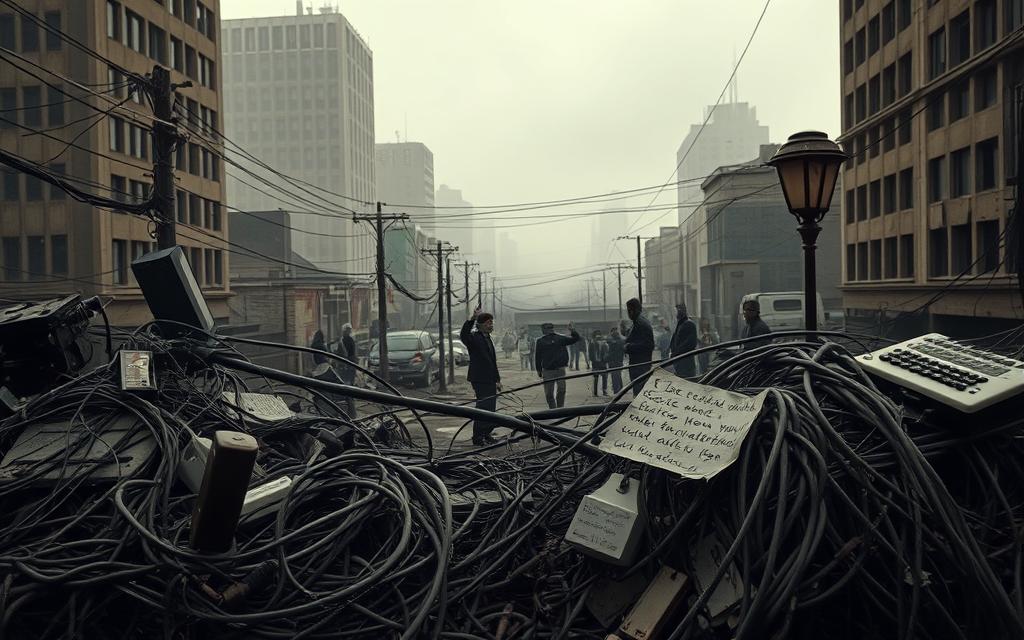
Letters that now take seconds to send would take weeks. This would slow down business and change how we keep in touch.
Social Structures Regressing to Pre-Industrial Eras
Without tech, we’d move back to old ways of living. People would focus on what’s close to them. The idea of being a global citizen would fade.
This change would affect how we think and live. We’d have more patience and focus on local relationships.
Community Reliance and Localised Governance
Communities would become the main focus of society. Neighbourhoods and towns would look after themselves, making decisions and sharing resources.
This would bring both challenges and benefits. We’d lose global views but gain closer, more responsive communities.
| Communication Method | Pre-Tech Era | Modern Tech Era | Post-Tech Scenario |
|---|---|---|---|
| Message Delivery Time | Days/Weeks | Seconds | Days/Weeks |
| Information Access | Localised | Global | Hyper-local |
| Social Organisation | Community-based | Network-based | Community-based |
| Governance Scale | Local | National/Global | Local |
This table shows how communication and society would go back to old ways without technology. It highlights the importance of being close to each other.
Daily Life Reimagined: Personal and Domestic Struggles
Imagine waking up to a world without modern conveniences. Your morning routine would change to tasks our ancestors knew well. We’ve forgotten these tasks, making our daily activities and comforts hard to keep.
Household Management Without Modern Appliances
Life without tech would make household chores a full-time job. Cleaning, cooking, and keeping a home tidy would take a lot of effort. These tasks, once easy with machines, now require constant manual work.
Food Sourcing, Preparation, and Storage Challenges
Without refrigeration and modern kitchens, food management becomes an endless daily challenge. Families would need to find local ingredients and cook meals right away. Traditional methods like salting, drying, or smoking would be the only ways to preserve food.
Preparing dinner would feel like camping. Every meal would need to be made from scratch. The idea of quick meals or convenience foods would be gone from our lives.
Evening entertainment would be simpler. We’d read by candlelight, tell stories, or play handmade games. This change in domestic life without tech would deeply affect family life and our daily routines.
“The loss of modern conveniences would return us to a subsistence existence where every calorie consumed must be earned through physical effort.”
Transportation and Mobility Reduced to Basics
The loss of modern vehicles and infrastructure would make transportation challenges a big issue. Our freedom to move would disappear, replaced by limited options based on distance and human endurance.
Dependence on Animal Power and Human Labour
With cars, trains, and planes gone, we’d go back to old ways of moving. Walking and animal-drawn carts would be the main ways to travel long distances.
The table below shows how travel would be much harder:
| Transport Method | Average Speed | Maximum Range | Cargo Capacity |
|---|---|---|---|
| Walking | 5 km/h | 30 km/day | What can be carried |
| Horse-drawn cart | 8-12 km/h | 40 km/day | 500-800 kg |
| Bicycle | 15-20 km/h | 80 km/day | Limited personal items |
| Animal packing | 5-8 km/h | 25 km/day | 100-200 kg |
This change in mobility would make communities smaller and more isolated. It would affect jobs, healthcare, and social connections. We’d lose the global connections we have today.
Using manual labour for travel would change our bodies and how we manage time. Commutes would take hours, and moving goods would need teamwork.
Some might see benefits in this simpler life. Life without tech could mean reconnecting with nature and living more slowly. But, life without tech would be hard, with constant effort and less freedom.
This hard life would change our bodies and what we think of work. Manual labour would be all we do, not just a job.
Economic and Industrial Catastrophe
The loss of technology would lead to a huge change in our economy. Our global economy, built on digital tools and fast communication, would fall apart quickly.
Collapse of Global Trade and Complex Economies
Trade would stop right away without digital payments and communication. Stock markets would disappear, banks would fail, and digital money would lose all value.
Return to Agrarian and Barter Systems
Our society would quickly go back to local economies. People would trade food, tools, and labour directly. The barter system would become the main way to exchange goods and services.
Mass Unemployment and New Labour Realities
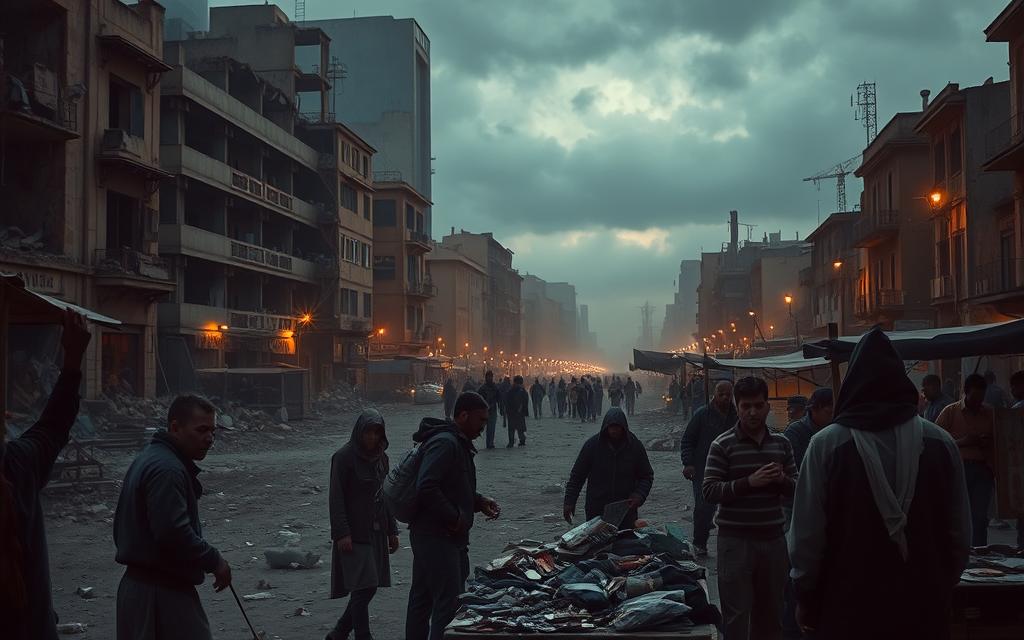
The unemployment crisis would hit hard and fast. Millions in tech, finance, and service jobs would lose their jobs instantly. Jobs in tech and finance would disappear faster than in manufacturing.
Shift to Manual and Skilled Craft Work
Surviving would depend on practical skills, not digital ones. Key jobs would include:
- Blacksmiths and metalworkers
- Carpenters and builders
- Farmers and agricultural workers
- Medical practitioners using traditional methods
This economic collapse would make us rethink what’s valuable in work.
Healthcare and Scientific Advancement Grinds to a Halt
The loss of technology would cause a huge collapse in medical and scientific fields. These are key for our survival and progress. It would send us back centuries in healthcare and knowledge.
Medical Care Reverting to Ancient Practices
Modern hospitals would stop working without technology. Things like diagnostic tools and monitoring systems would fail. Doctors would have to use old methods to examine patients.
Surgeries would become very dangerous without modern tools. Many life-saving operations would be too risky to do. Doctors would have to rely on old ways of treating patients.
Rising Mortality Rates and Public Health Crises
This medical step back would be very bad. More people would die, no matter their age or illness. Diseases would be hard to diagnose and treat on time.
Public health would fail. Vaccines and medicines would stop being made. Diseases that were once controlled would come back. Conditions like diabetes and cancer would be deadly for many.
Stagnation in Research and Loss of Knowledge
Science would stop making progress. Labs would be useless without power and tools. All the data and research we have would be lost.
There would be no new discoveries in genetics or disease treatments. The global research network would break down. This would be a huge loss for science.
Educational Systems Forced to Oral Traditions
Education in medicine and science would go back a long way. Without digital tools, teaching new doctors would be hard. Learning would have to go back to old ways.
Universities and medical schools would struggle. They need technology to teach complex medical knowledge. This would make it hard to keep and share knowledge.
Not having technology in healthcare and science is a big problem. It would not just slow down medical care. It could erase all the progress we’ve made and shorten lives.
Conclusion
Looking into a future without technology shows us a world without our modern comforts. It reveals how much we rely on technology in our daily lives. This dependency affects every part of our lives.
Despite the challenges, humans have always found ways to adapt. Even in extreme situations, we’ve shown great resilience. This ability to change is our strongest asset.
This thought experiment is not meant to predict the future. It’s a way to make us think about our relationship with technology. It reminds us to value innovation but also to know our limits.
FAQ
What would be the most immediate effects if all technology suddenly vanished?
If all technology vanished, we’d lose essential services like electricity, water, and gas. These services rely on computers. Chaos would erupt, and life would return to basic survival modes quickly.
How would communication be affected in a world without technology?
Without tech, global communication networks would fail. We’d have to use slow methods like handwritten letters and talking. This would change how we share info and keep in touch.
What would happen to modern transportation systems without technology?
Cars and transport systems, needing tech to work, would stop. We’d have to walk, use animals, or rely on our strength. This would limit how we move and change our daily lives.
How would the economy be impacted by the disappearance of technology?
The loss of tech would crash global trade and finance. We’d go back to farming and bartering. Tech jobs would vanish, but manual skills would be in demand.
What would healthcare look like without modern medical technology?
Healthcare would go back to old ways, with more mistakes and deaths. Without modern tools, treatments, and sanitation, health crises would rise.
Would scientific progress continue in a technology-free world?
Science would stop without modern tools and data analysis. We’d lose knowledge as schools fail. We’d rely on oral traditions and apprenticeships.
How would social structures change without technology?
Without tech, societies would become very local, like before the industrial era. Communities would look out for themselves, and leaders would be very close to home.
What challenges would arise in managing households without technology?
Running a home would be hard without tech. Finding, preparing, and storing food would take a lot of effort. Life would need more time, energy, and creativity.